
How to Plan a Houseboat Trip in Kerala: Itinerary, Packing and Booking
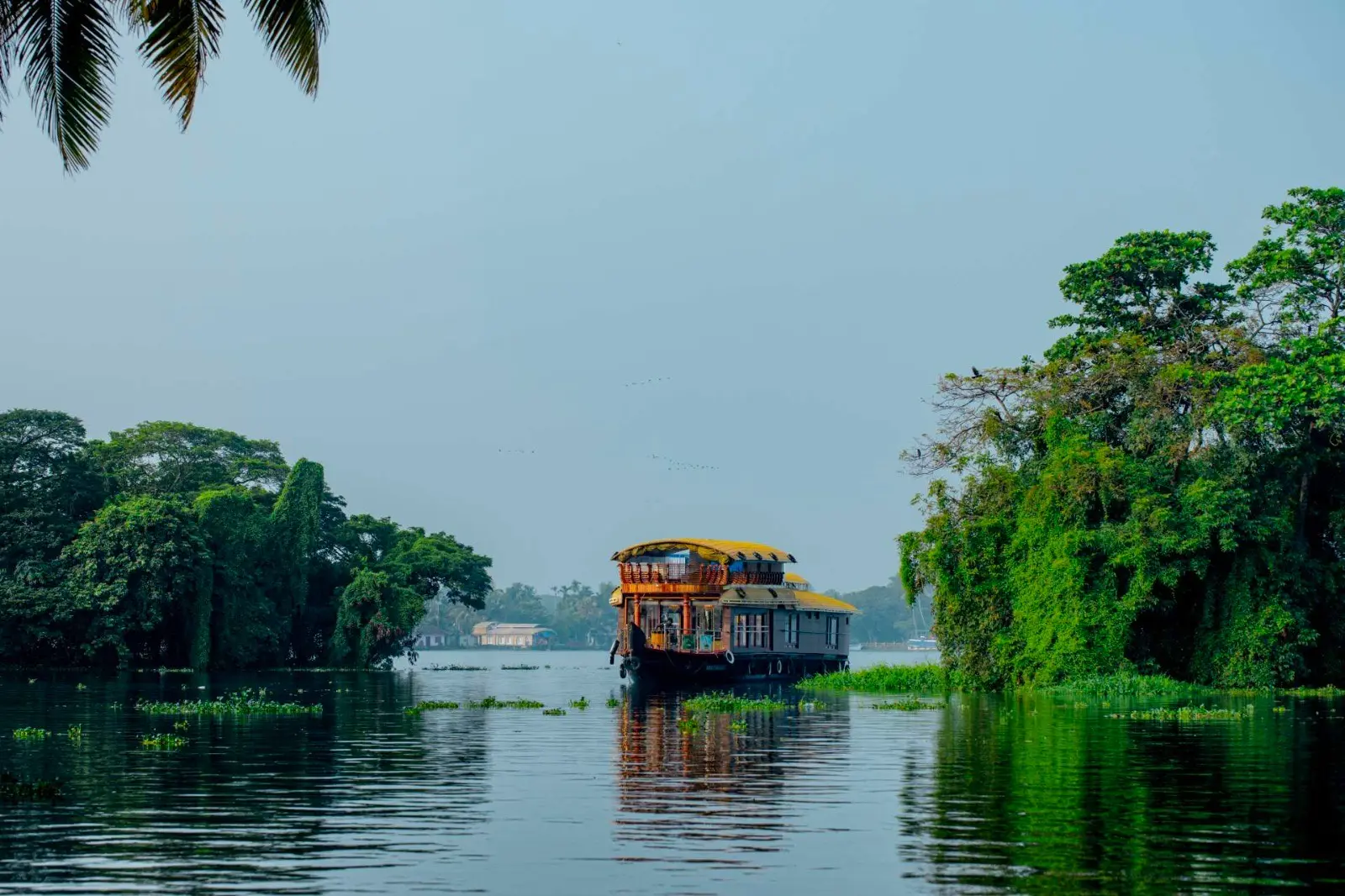
A houseboat trip in Kerala is one of the easiest things in India to book and one of the easiest to get mildly wrong. The boats look alike in photographs, the rates swing by a factor of three across the year, and the two decisions that most affect whether you enjoy it — which month you come and how many bedrooms you take — are rarely the ones people agonise over.
This is the planning guide we would give a friend: what the day actually looks like, when to come, what the tiers mean in practice, what to pack, and how to end up on a specific boat rather than whatever is free. Every figure here is from our own fleet of 59 boats on the Alleppey backwaters, and you can check all of them against the 2026 price list.
First, what you are actually booking
You are chartering a converted kettuvallam — a rice barge, re-decked with bedrooms, a lounge and a kitchen — with a crew of three: a captain, an engineer and a cook. On a private booking the boat is yours alone. It is not a cabin on a larger vessel, and it is not a cruise with a fixed passenger list.
The shape of the day surprises people, so it is worth setting out before anything else.
A night aboard, hour by hour
Noon check-in to 9 AM check-out. Most of it is not spent moving.
- 12:00 PM Board at Punnamada
Check in at the Nehru Trophy Finishing Point. Welcome drink, bags to your room, and the boat pushes off.
- 12:30 PM Lunch while cruising
Served as you move out through the canals — rice, a fish curry, vegetable dishes, all cooked aboard.
- 1–4 PM Open lake and village canals
Across Punnamada and Vembanad, then into the narrow Kuttanad channels. The best stretch of the day.
- 4:00 PM Tea and snacks
Usually on the upper deck, often while the boat is turning back toward its mooring.
- 5:00 PM Anchor for the night State rule
Cruising stops — a state rule for safety, not an operator choice. The boat moors off a village bank.
- 5–9 PM The quiet part
Still water, engine off, no road and often no other boat in sight. Dinner is cooked while you sit out.
- 7:00 AM Cruising resumes
A short morning run, usually the prettiest light of the trip. Breakfast is served aboard.
- 9:00 AM Check out
Back at the finishing point. Twenty-one hours, door to door.
The ratio matters more than any single item on that list. You board at noon and check out at nine the next morning — twenty-one hours — and roughly four and a half of those are spent moving. The rest is spent anchored.
That is not an operator cutting corners. Kerala requires houseboats to stop cruising at 5:00 PM and stay moored until 7:00 AM, for safety on water shared with fishing boats and ferries. Every operator on the backwaters works to the same clock.
It also happens to be the best part. From five in the afternoon the engine is off, the boat is tied off a village bank, and there is usually no road, no other boat and no noise beyond birds and someone’s television across the water. Guests who describe the trip afterwards almost never lead with the cruising.
When to go
If you take one thing from this article, take this. The month you choose changes the price by more than the tier does, and it changes the experience more than the boat does.
When to go
The month changes your bill more than the boat does. You are looking for dark Comfort against light Price — October, and the second half of June through September.
| Jan | Feb | Mar | Apr | May | Jun | Jul | Aug | Sep | Oct | Nov | Dec | |
|---|---|---|---|---|---|---|---|---|---|---|---|---|
| Comfort darker is better | Jan: High | Feb: High | Mar: Mid | Apr: Low | May: Low | Jun: Mid | Jul: Mid | Aug: Mid | Sep: Mid | Oct: High | Nov: High | Dec: High |
| Crowds darker is busier | Jan: High | Feb: Mid | Mar: Mid | Apr: Low | May: Low | Jun: Low | Jul: Low | Aug: Mid | Sep: Mid | Oct: Mid | Nov: High | Dec: High |
| Price darker is dearer | Jan: High | Feb: Mid | Mar: Mid | Apr: Low | May: Low | Jun: Low | Jul: Low | Aug: Low | Sep: Mid | Oct: Mid | Nov: High | Dec: High |
December and January are the most comfortable weeks of the year — cool nights, clear light, no humidity to speak of — and they are priced accordingly. Weekends and public holidays carry a premium over midweek dates in the same month, and the good boats go first. If you want this window, book early and come on a Tuesday.
February through May gets hot. By one in the afternoon the upper deck is unusable without shade, and the cabin becomes somewhere you actually want to be. This is the one time of year we would push you up a tier: on a Deluxe boat the air conditioning runs overnight only, and in April that is a long afternoon.
June through September is the monsoon, and it is badly undersold. The paddy fields are flooded and brilliant green, the canals are full, the rain tends to arrive in heavy bursts rather than all day, and rates are at their lowest of the year. If you are flexible and you do not mind getting wet, this is where the value is.
October and November are the quiet compromise — the rain easing off, the landscape still green from it, the Christmas crowds not yet arrived.
Choosing the boat: bedrooms first, tier second
Most people start by choosing a tier. Start with bedrooms instead, because that is what actually sets the price.
Count two guests per bedroom. A couple needs one. A family of four needs two. Eight people are better off on one four-bedroom boat than on two smaller ones — they eat together, nobody is separated overnight, and the per-head cost drops. For a day cruise bedrooms barely matter at all, since nobody sleeps: a boat that sleeps eight overnight will comfortably carry a day group of thirty.
Only then think about tier, which in practice means one question: when does the air conditioning run?
- Standard — non-AC, ceiling fans, windows on both sides with netting
- Deluxe — air conditioning from 9:00 PM to 7:00 AM, overnight only
- Premium — air conditioning on demand, larger rooms, better bathrooms
- Luxury — air conditioning on demand, wider boats, upper decks, panelled interiors
The overlap in that chart is the useful part. The tiers are not four price brackets stacked neatly on top of each other — they are four overlapping bands, and a large Deluxe boat costs considerably more than a small Luxury one. If you are travelling as a couple, moving from Deluxe to Luxury costs less than adding a second bedroom you do not need.
There is also a shared option, where you book one private lockable bedroom on a boat carrying several and share the deck and dining table. It is the cheapest way to spend a night on the backwaters. It is the wrong choice for a honeymoon, and it runs to a fixed departure rather than yours.
What to pack
Less than you think, and specifically not the things most people bring.
What to pack
Bring these
- Mosquito repellent The single most forgotten item. Evenings at anchor are when they arrive.
- Sunscreen and a hat The upper deck has no shade for most of the afternoon.
- A light layer Cool on the water after dark, especially December and January.
- Photo ID for every adult Checked at boarding. Passport for foreign nationals.
- Any medication you need The boat anchors away from shops from 5 PM.
- A power bank There are sockets, but the generator rests overnight on some boats.
Already aboard
- All meals and drinking water Lunch, tea, dinner, breakfast. Mineral water throughout.
- Bedding, towels and linen Changed for every booking.
- En-suite bathroom with hot water In every bedroom, on every tier.
- Life jackets Including child sizes — ask the crew on boarding.
- Basic first aid The crew carry a kit.
Leave behind
- Heavy luggage Cabins are compact. A soft overnight bag beats a suitcase.
- Drone, unless you have asked Restricted over parts of the backwaters; check with us first.
- Expectations of fast data Signal drops in the narrow Kuttanad channels. That is rather the point.
The repeated mistake is luggage. Cabins are compact and there is nowhere to store a large suitcase, so a soft overnight bag is worth repacking for. The repeated omission is mosquito repellent — the boat anchors beside vegetation at dusk, which is exactly when and where you want it.
Day cruise or overnight
A day cruise runs from about 11:30 AM to 5:00 PM and covers the same water the overnight boats cover on their first afternoon, with lunch cooked aboard. It starts at ₹6,500 for a private boat without meals, or ₹7,500 with.
It is the right choice if you have one day in Alleppey, if you are travelling with small children for whom a night aboard is a stretch, or if you are putting together an office outing where the per-head cost falls sharply with numbers. Six people on a ₹7,500 cruise pay ₹1,250 each.
What you give up is the evening — and the evening is the thing. If the choice is between a day cruise in December and an overnight in July, take the overnight in July.
How to book a specific boat
The main pricing problem in this market is not seasonal surcharges, it is the layer in between. Aggregators add a commission to the operator’s rate and present the result as a best price, and travellers sometimes arrive to find a different boat from the one in the listing — a complaint we hear often enough that it is worth naming.
Booking directly avoids both. What to insist on, from whoever you book with:
- A named boat, not a category. “A 2-bedroom Premium” is not a booking; a specific boat is.
- Whether the price is per boat or per person. This single ambiguity causes most of the confusion in Kerala houseboat pricing. Ours are per boat.
- Whether GST is included. Ours is charged on top of the displayed rate.
- Cancellation terms in writing, before the advance. Ours: more than 15 days out, a ₹1,000 charge; within 15 days, 50%; no-show or within 72 hours, the full amount.
- Confirmation against a live schedule, not a provisional hold.
We run our own boats and publish our own rates, so the figure on the page is the figure you pay before GST. Send your dates and group size on WhatsApp and we check the live schedule before asking for anything.
A sensible first trip
If you want the short version: one night, not two. A houseboat night is concentrated and it works because it does not outstay itself — the second day covers similar water. Pair one night aboard with a few days on land.
Come in October or February if you want the balance of weather and price, or in July if you want the backwaters at their greenest for the least money. Take one bedroom per two people, and spend the difference on a tier with daytime air conditioning only if you are travelling between February and May.
Board by 11:30 AM so you get the full afternoon, bring repellent, and leave the suitcase at the hotel.
Ready to put dates to it? Browse all 59 houseboat packages, check the 2026 rates, or read what the price differences actually buy you.
Ready to check real availability?
Every rate in this article is our published price. Send your dates and group size and we confirm against the live schedule before asking for anything.